Trusted CI released a resource mapping the NSF Critical Controls to the CIS Controls (v8.1). This resource was designed to help organizations understand and apply the NSF Critical Controls by highlighting the equivalent CIS Safeguards, alongside Trusted CI commentary. This mapping represents Trusted CI’s interpretation and translation of the NSF language used for each control.
Wednesday, July 15, 2026
Trusted CI Releases NSF Critical Controls Mapping to the CIS Controls
Thursday, January 15, 2026
Trusted CI Completes Two Assessment Pilots with Cohort Graduates
The second half of 2025 was incredibly productive for the Trusted CI team. After a successful cohort in the first half of 2025, Trusted CI shifted efforts to piloting two new kinds of assessments: a Trusted CI Framework reassessment for organizations who previously participated in a Trusted CI Framework cohort program and a Cybertrack+ Assessment with NOIRLab focused on assessing the most important cybersecurity controls.
Trusted CI Framework Reassessment Cohort Pilot
| CENIC reassessment presentation |
| Reassessment Workshop in Boulder, CO |
Trusted CI Cybertrack+ Assessment Pilot with NOIRLab
Wednesday, December 10, 2025
Ships, Winches, and Cybersecurity: Trusted CI at RVTEC
![]() |
| RVTEC attendees, Scripps Institution of Oceanography |
In November, members of Trusted CI attended the 2025 UNOLS RVTEC Meeting in La Jolla, CA. The RVTEC (Research Vessel Technical Enhancement Committee) Meeting, “brings together marine technicians, engineers, and vessel operators from the U.S. Academic Research Fleet (ARF) and other agencies to share knowledge, advance best practices, and collaborate on technical solutions.”
The team contributed to many of the sessions on Cyber Monday, including a cybersecurity update from the Academic Research Fleet, the Secure by Design Operational Technology Vendor Procurement Matrix, and how-tos on developing a cyber risk assessment, an incident response plan, and cyber-incident drills.
During Mike Simpson’s presentation reviewing the 2025 activities of ARFSEC (the team that runs the fleet-wide cybersecurity program), he announced a new Ship Site Visit template that Trusted CI developed to collect information during NSF inspections of the ARF’s vessels. The purpose of the template is to document details about a vessel’s cybersecurity and cyberinfrastructure (CI) in order to identify what gaps might need attention. The template has been field tested during visits to the RV Sikuliaq, the RV Atlantic Explorer, the RV Rachel Carson, and will be used in the inspection of the RV Neil Armstrong.
The template can be found here: https://doi.org/10.5281/zenodo.17807879
The 5-day meeting was packed with presentations, trainings, breakout sessions, and an impressive tour of the Scripps Nimitz Marine Facility.
Maritime vessels in the U.S. Academic Research Fleet are arguably the most complicated pieces of cyberinfrastructure in the NSF research infrastructure portfolio, and as such have complex and changing cybersecurity requirements. Trusted CI looks forward to continuing to support the ARF and the scientific progress that it enables.
![]() |
| Slide from SatNAG update displaying CI resources available to the fleet |
| Helm control panel on the R/V Sally Ride |
| Test bench at the Shipboard Technical Support Calibration Lab |
| R/V Sally Ride |
Wednesday, October 15, 2025
Trusted CI Ambassador Engagement at the EarthScope Retreat
Earth’s movements tell a story, from shifting tectonic plates to subtle tremors beneath the Earth’s surface; movements that uncover the Earth’s ever-changing dynamics. Understanding that story requires precise, continuous measurements, and EarthScope provides the infrastructure to make this possible. The facility supports transformative research and education in the geosciences, offering a global community of scientists and educators access to instrumentation, observations, and infrastructure that help decode the physical processes of our planet.
In September 2025, Trusted CI Ambassador Megha Moncy attended the EarthScope Data Services Retreat in Warwick, Rhode Island, spending three engaging days with the dedicated staff. At the retreat, she had the chance to meet the Data Services team face-to-face and share insights on how Trusted CI supports NSF facilities. She connected with researchers, managers, and leadership, gaining a deeper understanding of EarthScope and exploring practical ways to integrate cybersecurity into day-to-day operations.
Bridging Science and Cybersecurity
As part of her ongoing Ambassador engagement, which includes regular check-ins with Rob Casey, Moncy serves as a liaison between EarthScope and the broader Trusted CI team. She connects the facility with the right cybersecurity expertise, offering guidance on information security, risk management, and other security needs tailored to support the facility’s mission. Building on this ongoing work, the retreat provided an ideal setting for Moncy to highlight how smart, mission-focused cybersecurity can enable groundbreaking scientific work and support EarthScope’s research effectively.
![]() |
| Megha Moncy, Trusted CI Ambassador to EarthScope presenting cybersecurity insights to the EarthScope team. |
During her 30-minute session, Moncy presented Trusted CI’s core mission and the need for helping research facilities find the sweet spot between pushing the boundaries of science and managing cybersecurity risk. From there, she guided attendees through the Trusted CI Framework’s four pillars, Mission Alignment, Governance, Resources, and Controls; demonstrating how each pillar provides practical guidance to strengthen security while supporting the facility’s scientific mission. The session also explored the challenges and opportunities of securing operational technology (OT) and Internet of things (IoT) - enabled instruments. Moncy also highlighted the “Secure by Design” approach, explaining how building security into systems from the start can prevent problems that would be much harder to fix later.
Beyond her formal presentation, Moncy participated in team-building activities and lunches with leadership and management. These moments allowed informal conversations about cybersecurity priorities, potential collaborations, and the ways Trusted CI can support EarthScope’s mission. Amid the retreat, some exciting news arrived: EarthScope Consortium received the much awaited National Geophysical Facility (NGF) award, opening the door to expanded resources and new opportunities, including for strengthening cybersecurity across the facility.
Reflections from the Retreat
Attending the EarthScope retreat gave Moncy the opportunity to connect with staff and gain an up-close view of the inner workings of a major geophysical facility. She observed a team deeply committed to advancing Earth science and was able to share insights on how Trusted CI’s guidance and services can help strengthen the security and resilience of that work. She is especially grateful to Rob Casey for the invitation to participate, to the organizers who made the retreat run so smoothly, and to the EarthScope staff whose engagement, curiosity, and energy made the three days fly by. The experience left her inspired by the team’s dedication and the collaborative spirit that drives discovery at EarthScope, and she looks forward to many more opportunities to work together.
Tuesday, September 2, 2025
Trusted CI Celebrates Sixth Cohort Graduation & Opens Call for 2026 Engagement
Trusted CI’s sixth Framework Cohort, “Foxtrot”, successfully completed the six-month program of training and workshop engagement focused on learning and applying the Trusted CI Framework. The Cohort members entered the engagement with a commitment to adopting the Framework at their organizations. They then worked closely with Trusted CI to gather facility information and create validated self-assessments of their cybersecurity programs based on the Framework. Each organization also emerged with a draft Cybersecurity Program Strategic Plan (CPSP) identifying priorities and directions for further refining their cybersecurity programs. Foxtrot cohort included the following research-oriented organizations:
ALMA | DERConnect | UC Davis | US ATLAS | ZEUS
"Participating in the Trusted CI Cohort was an excellent experience and brought significant value to our team. As a research group working at the intersection of the power grid and renewable energy, cybersecurity is critical for both our daily operations and the broader transition to smarter, more connected technologies. The cohort facilitators provided expert guidance and a practical framework that helped us clarify our cybersecurity risks, baseline controls, stakeholder responsibilities, and more. Through their collaborative and thorough approach, we developed an actionable, strategic plan and gained a holistic understanding of our security posture. With this training, we feel empowered and better prepared to implement a robust cybersecurity program, strengthening both our research and industry collaborations."
- Keaton Chia, R&D Engineer and Project Manager, DERConnect
2026 Framework Cohort Call for Participation Open
Trusted CI has a few spots left for the 2026 Framework Cohort engagement (starting January 2026). To learn more or to submit the interest form for your organization, visit trustedci.org/framework/cohort-participation.
Engagement with RISC
Concurrent with leading Foxtrot, Trusted CI continued quarterly engagement with graduates of the five previous Framework cohorts through the Research Infrastructure Security Community (RISC). Trusted CI established RISC as a community of practice to provide a forum for cohort graduates to expand their cybersecurity knowledge, share experiences, and build relationships within the NSF research cyberinfrastructure community.
For more information, please contact us at framework@trustedci.org.
Thursday, July 31, 2025
Trusted CI visits IceCube
![]() | |
| Trusted CI staff member Megha Moncy holding one of the many hard drives shipped back from the South Pole containing neutrino research data |
In June 2025, members of the Trusted CI team took the opportunity to tour the IceCube Neutrino Detector data center and development facility at the University of Wisconsin - Madison. The team learned about the custom designed sensors and equipment that make up the 1 cubic kilometer detector buried under 1.5 km of ice at the South Pole.
Because the detector produces about 1TB per day of data, and satellite communication to the South Pole is limited, it's still far more efficient to ship hard drives back to the lab after a season of data collection at the detector is finished. However, because the data is so valuable, they write the data to at least two separate arrays of hard drives and ship them on separate logistical channels in case of catastrophe during shipment.
![]() |
| Steve Barnet (right), giving a tour of the IceCube development facility. |
The IceCube sensors, which are called "digital optical modules", are about the size of a basketball but surprisingly weigh more than a bowling ball. Most of the weight is owed to the thick glass in each sensor pod that shields the sensitive electronics and photomultipliers from the 1 to 2 kilometers of ice that sit above them. The unique sensors were designed and built by several institutions within the international IceCube Collaboration to withstand the extreme environment of Antarctica.
![]() |
| Trusted CI staff member Mark Krenz holding one of the digital optical modules. |
Neutrinos are a fundamental particle generated by the universe's most extreme events such as supernovae and black holes. They travel in straight lines from their origin through the universe, passing through ordinary matter. As neutrinos pass through the Earth from all directions, including through the core of the planet, neutrinos whose path takes them through the south pole IceCube detector pass through the large cubic kilometer of ice making up the array. Most of them pass right through the detector without any interaction, but occasionally they hit an atom in the ice and generate secondary charged particles which travel through the ice faster than light travels through ice. This produces Cherenkov radiation, which creates a blue flash of light. This blue light phenomenon of Cherenkov radiation is what the photomultipliers actually detect.
![]() |
| IceCube's testing and development array of sensors. |
The facility also has a test array of sensors that are not encased in glass and stacked closely together that allow IceCube staff to run tests and diagnostics on the electronics before performing the same operations on the production sensor array. This reduces the chance of an incident that damages the entire array, "which would be bad", according to Steve (he likes understatement). Availability is a crucial security requirement for the IceCube array, and one of the threats against the sensors continuing to function is the extreme cold damaging the electronics inside. If the array loses electricity, it would only be a matter of a day or so before large parts of the array would become unrecoverable. Thus, it is important that a generator powering the array in Antarctica run continuously uninterrupted over the lifetime of the experiment. Trusted CI benefits from visiting the IceCube facility by seeing the equipment and better understanding the processes used to program, deploy, and protect the equipment from a variety of security threats.
Monday, March 10, 2025
Trusted CI and the Research Infrastructure Security Community Respond to NSF’s Draft Research Infrastructure Guide
Trusted CI, in collaboration with the Research Infrastructure Security Community (RISC), submitted comments to the U.S. National Science Foundation (NSF) regarding Section 5.3 of NSF’s 2025 draft Research Infrastructure Guide (RIG). These comments offer the community’s perspective on the NSF’s proposed new guidance for Major Facilities and Mid-Scales on building their cybersecurity programs.
RISC is a community of practice built by Trusted CI for NSF-funded cybersecurity professionals. RISC is composed of graduates from the Trusted CI Framework Cohort Program, who continue to gather as a community to expand their cybersecurity knowledge, share experiences, and build relationships.
For more information, please contact us at info@trustedci.org.
Monday, October 7, 2024
Announcing the Publication of v2 of the Trusted CI OT Procurement Matrix & Companion Guide
Last year, the Secure by Design team announced the publication of the first version of the Trusted CI OT (Operational Technology) Procurement Matrix. After gathering feedback from maritime operational technology practitioners and some of their vendors, we have published an updated version of the Matrix and a companion Guide to further assist the OT community.
The Guide can be found here: https://doi.org/10.5281/zenodo.13743314
The purpose of the Matrix is to assist those in leadership roles during the procurement process. It’s meant to help formulate questions for vendors to discuss security controls on devices that will be used for maritime research. The Matrix includes a list of controls, requirements for the control, potential questions for vendors, tips, and real world examples justifying a given control.
The updates to v2 of the Matrix includes columns for ISO/IEC 27000 family and the ISA/IEC 62443 Series of Standards.
The updated version of the Matrix can be found here: https://doi.org/10.5281/zenodo.10257812
We have already seen positive impacts from this document. “Even at our project stage of construction, where a majority of OT procurements are complete and fulfilled, we find the OT Vendor Procurement Matrix to continue to be useful," Christopher Romsos, Datapresence Systems Engineer for the Regional Class Research Vessel (RCRV) said. "Despite having contracts in place and work well underway at the time the matrix was published, we realized that the OT Vendor Procurement Matrix could be leveraged as a discovery tool to inform our Cyber Risk Management Planning needs. We're in a more informed position now for our CRMP activities because the matrix provided us with something we could easily use in the field and that was designed to assess cyber risk in OT systems,” he said.
The Secure by Design team will be moderating a panel for in-person attendees later this week at the NSF Cybersecurity Summit. The Matrix will surely come up as a discussion topic.
Monday, July 15, 2024
Advancing the Cybersecurity of NSF Cyberinfrastructure: Trusted CI Graduates its Fifth Framework Cohort
Trusted CI’s fifth Framework Cohort, “Echo”, successfully completed the six-month program of training and workshop engagement focused on learning and applying the Trusted CI Framework. Cohort members entered the engagement with a commitment to adopting the Framework at their organizations. They then worked closely with Trusted CI to gather site information and create validated self-assessments of their facility’s cybersecurity programs based on the Framework. Each organization also emerged with a draft Cybersecurity Program Strategic Plan (CPSP) identifying priorities and directions for further refining their cybersecurity programs. Echo cohort included the following research cyberinfrastructure providers:
Compact X-ray Free Electron Laser (CXFEL)
Inter-university Consortium for Political and Social Research (ICPSR)
National High Magnetic Field Laboratory
Security and Privacy Heterogeneous Environment for Reproducible Experimentation (SPHERE)
Thirty Meter Telescope International Observatory (TIO)
The foundation of the cohort program is the Trusted CI Framework. The Framework was created as a minimum standard for cybersecurity programs. In contrast to cybersecurity guidance focused narrowly on cybersecurity controls, the Trusted CI Framework provides a more holistic and mission-focused standard for managing cybersecurity. For these organizations, the cohort was their first formal training in the Trusted CI Framework “Pillars” and “Musts” and how to apply these fundamental principles to assess their cybersecurity programs.
Feedback on the program from cohort participants has been strongly positive.
Jim Berhalter, Director of IT for the National High Magnetic Field Laboratory at Florida State University, said: “The Trusted CI cohort has been invaluable to our organization and I would highly suggest participating. While some of it can be daunting, it was a comprehensive way to structure a cybersecurity plan for our organization and made me think about things I would’ve never thought about for our cybersecurity infrastructure.”
Joe Saul, Privacy and Security Officer, Adjunct Research Assistant Professor for ICPSR at University of Michigan, said: “Participating in the Trusted CI cohort was a rare opportunity. You get to learn from others who are facing some of the same challenges you are, and share your own experiences. You get to work with the Trusted CI team, who have talked to a LOT of other groups in similar situations, and hear their read on how you’re doing. Maybe most importantly, they help you take a step back and evaluate your own program and where you’re going. All of this for free. If you get the chance, jump at it. It’s a lot of work, but you aren’t going to get this anywhere else. And certainly not for free.”
Concurrent with leading Echo, Trusted CI continued quarterly engagement with graduates of the four previous Framework cohorts through the Research Infrastructure Security Community (RISC). Trusted CI established RISC as a community of practice to provide a forum for cohort graduates to exchange cybersecurity experience, best practices, challenges, etc., within the NSF research cyberinfrastructure community.
Trusted CI plans to use the second half of 2024 to implement a number of cohort program improvements based on participant feedback and lessons learned during the previous five cohort engagements. The Framework Team plans to implement improvements that enhance cohort participants' experience and increase potential impacts.
For more information, please contact us at info@trustedci.org.
Labels: cybersecurity programs, framework, major facilities
Wednesday, May 8, 2024
Highlights from the 2024 NSF Research Infrastructure Workshop
The RIW officially began on a Tuesday, but Trusted CI held its quarterly Research Infrastructure Security Community (RISC) meeting the day before, taking advantage of a number of Framework cohort members traveling to Tucson to attend the RIW. The RISC meeting included a presentation from NSF’s Cybersecurity Advisor for Research Infrastructure, Mike Corn, to discuss the upcoming revision of the NSF Research Infrastructure Guide and potential changes related to cybersecurity. On Tuesday evening, Trusted CI’s “Secure by Design” team participated in the poster session. Their poster, “Cybersecurity Risks to Large Science Projects,” won second place in the poster competition.
Overall, the RIW program agenda emphasized topics that impact members of the Trusted CI community, notably the tracks on Cyberinfrastructure (Tuesday) and Cybersecurity (Thursday), as well as a plenary talk on Friday that covered a recent cybersecurity incident at one of the NOIRLab sites.
On Wednesday, in-person attendees were given the opportunity to join one of three different tours organized by the event committee: Kitt Peak National Observatory, Biosphere 2 or the Richard F. Caris Mirror Lab.
Trusted CI highly encourages members of the NSF cyberinfrastructure operations community to attend next year’s workshop and thanks the RIW organizers and co-hosts for another great event. Materials from this year's workshop will be posted soon to the NSF Research Infrastructure Knowledge Sharing Gateway.
Wednesday, February 7, 2024
Advancing the Cybersecurity of NSF Major Facilities and National Research Cyberinfrastructure: Trusted CI’s Framework Cohort Achievements in 2023
Trusted CI successfully conducted two more six-month engagements in its ongoing Cybersecurity Framework Cohort Program during 2023, mentoring 11 additional research cyberinfrastructure providers through Framework validated self-assessments and cybersecurity program strategic planning. The cohort during the first half of 2023 comprised representatives from the following NSF major facilities, mid-scale projects, and a scientific consortium:
IceCube Neutrino Observatory, an NSF major facility
United States Antarctic Program (USAP), an NSF major facility
Deep Soil Ecotron (DSE), an NSF mid-scale project
Network for Advanced NMR (NAN), an NSF mid-scale project
Giant Magellan Telescope Observatory Corporation (GMTO), a scientific consortium
Five of NSF’s leading high performance computing (HPC) centers composed the cohort during the second half of 2023:
National Center for Supercomputing Applications (NCSA)
Pittsburgh Supercomputing Center (PSC)
San Diego Supercomputer Center at UCSD (SDSC)
Texas Advanced Computing Center (TACC)
The foundation of the cohort program is the Trusted CI Framework. The Framework was created as a minimum standard for cybersecurity programs. In contrast to cybersecurity guidance focused narrowly on cybersecurity controls, the Trusted CI Framework provides a more holistic and mission-focused standard for managing cybersecurity. For these organizations, the cohort was their first formal training in the Trusted CI Framework “Pillars” and “Musts” and how to apply these fundamental principles to assess their cybersecurity programs.
Cohort members entered the engagement with a commitment to adopting the Framework at their sites. They then worked closely with Trusted CI to gather site information and create validated self-assessments of their organization’s cybersecurity programs based on the Trusted CI Framework. Each site emerged from the program with a draft Cybersecurity Program Strategic Plan (CPSP) identifying priorities and directions for further refining their cybersecurity programs.
Several participants provided feedback on the value of the cohort experience to their organizations.
GMTO’s Sam Chan, IT Director and Information Security Officer, and Efren Sandoval, Cybersecurity Analyst, noted that “...the cohort collaboration process has given us a better understanding of a holistic and mission focused approach to cybersecurity. The cohort collaboration process also brought us together with colleagues from different fields and requirements with similar security controls. Sharing our experiences amongst ourselves helped us learn different approaches to similar areas of concern.”
Michael Wilson, Infrastructure Architect at UConn Health and Cybersecurity Lead of NAN, observed: “As a result of the cohort experience, NAN was not only able to identify gaps in our original cybersecurity implementation plan and significantly advance our cybersecurity posture, but I have also personally expanded my professional network to share and discuss cybersecurity implementation ideas and lessons learned with colleagues from other NSF facilities. While the cohort program demands considerable effort, the NAN executive team found it to be a worthwhile endeavor. I heartily encourage the leadership of NSF facilities that have not yet participated in the cohort training to do so.”
Scott Sakai, Security Analyst at SDSC, found that: “Trusted CI’s Framework cohort provided a supportive environment to explore the strengths and weaknesses of the state of our cybersecurity efforts in the context of the Trusted CI Framework. While strengths were praised, shortcomings and challenges were met with non-judgmental, matter-of-fact discussion rather than punitive shaming: a response that promotes a path to resolution and understanding.”
Mr. Sakai also noted that: “Importantly, the Trusted CI Framework, and guidance from the Trusted CI cohort team emphasize the significance of governance and mission alignment – two foundational concepts that bring together cybersecurity and leadership, and help formulate what a meaningful dialog between the two might look like. This sets it apart from other approaches to a security program that focus on policy and controls, a difference that will hopefully foster an asset that is approachable and predictable instead of a mysterious line-item expense in the budget.”
In January 2024 Trusted CI began the fifth Framework cohort engagement, whose members include:
Compact X-ray Free Electron Laser Project
Inter-university Consortium for Political and Social Research
The National High Magnetic Field Laboratory
Security and Privacy Heterogeneous Environment for Reproducible Experimentation
Thirty Meter Telescope International Observatory
Trusted CI is excited to be working with these new sites to advance their understanding and implementation of cybersecurity programs and best practices!
For more information, please contact us at info@trustedci.org.
Friday, December 15, 2023
Announcing publication of the Operational Technology Procurement Vendor Matrix
![]() |
| RCRV Photo: The Glosten Associates |
The Trusted CI Secure by Design team has completed work on “The Operational Technology Procurement Vendor Matrix.” The purpose of this document is to assist those in leadership roles during the procurement process. It’s meant to help formulate questions for vendors to discuss security controls on devices that will be used for maritime research.
The matrix includes a list of controls, requirements for the control, potential questions for vendors, tips, and real world examples justifying a given control.
For example, Item #3 in the matrix is an inventory requirement stating that security vulnerabilities in vendor-provided software must be patched. The Threat Actor Example we cite to justify the requirement is the WannaCry vulnerability. We include an example question that could be used when discussing with the vendor. (Click the image below to see in better detail.)
The document can be viewed and downloaded here (Note: The file is available in many formats):
https://zenodo.org/doi/10.5281/zenodo.10257812
This document represents the work of many people, including critical feedback from maritime operational technology practitioners (Scripps Institution of Oceanography’s CCRV, and Oregon State University’s RCRV and OOI). We are grateful for their contributions to this effort.
Our goal is to share this matrix and continue to develop its utility after receiving feedback from the Trusted CI community. To contact us, email info@trustedci.org.
Monday, July 24, 2023
Updates on Trusted CI’s Efforts in Cybersecurity by Design of NSF Academic Maritime Facilities
As part of its “Annual Challenge” in 2023, Trusted CI has been engaging with current and future NSF Major Facilities undergoing design or construction with the goal of building security into those Facilities from the outset. To date, this effort has focused on working with cyberinfrastructure operators in the the academic maritime domain, and has included support of the cybersecurity aspects of the acceptance testing process of the NSF-funded Research Class Research Vessels (RCRVs) at Oregon State University as well as Scripps Institution of Oceanography’s design of the California Coastal Research Vessel (CCRV). These vessels are all expected to eventually become a part of the U.S. Academic Research Fleet (ARF).
In 2022, Trusted CI studied cybersecurity issues in operational technology (OT) in science and produced a roadmap to help lead to greater security of such systems, and thus Trusted CI’s efforts with security by design of Major Facilities this year are seeking to both refine and apply OT insights gained previously. The U.S. Antarctic Program (USAP)’s design of the Antarctic Research Vessel (ARV) has also been contributing to Trusted CI’s understanding of cybersecurity issues in operational technology Trusted CI has also benefited from insights from numerous conversations with domain experts in the academic maritime domain across a variety of ARF institutions, including IT personnel, marine technicians, oceanographers, ship captains, project leadership, and NSF Program Managers.
One of the highlights of this year's security-by-design efforts has been site visits to ships and facilities. The team has made site visits to the R/V Sally Ride and Oregon State University’s Hatfield Marine Science Center in Newport, Oregon, where the R/V Taani — one of the initial three RCRVs being constructed — will be based upon completion of its construction. These in-person visits, including extensive discussion with personnel involved with the facilities, have provided invaluable insight to supporting Trusted CI’s efforts.
In the second half of 2023, Trusted CI will continue working on security by design with the aforementioned organizations and will also be working with the NSF Ocean Observatories Initiative (OOI) Major Facility, which is in the process of planning a refresh of its autonomous underwater vehicle (AUD) and glider fleets.
Recent site visit photographs:
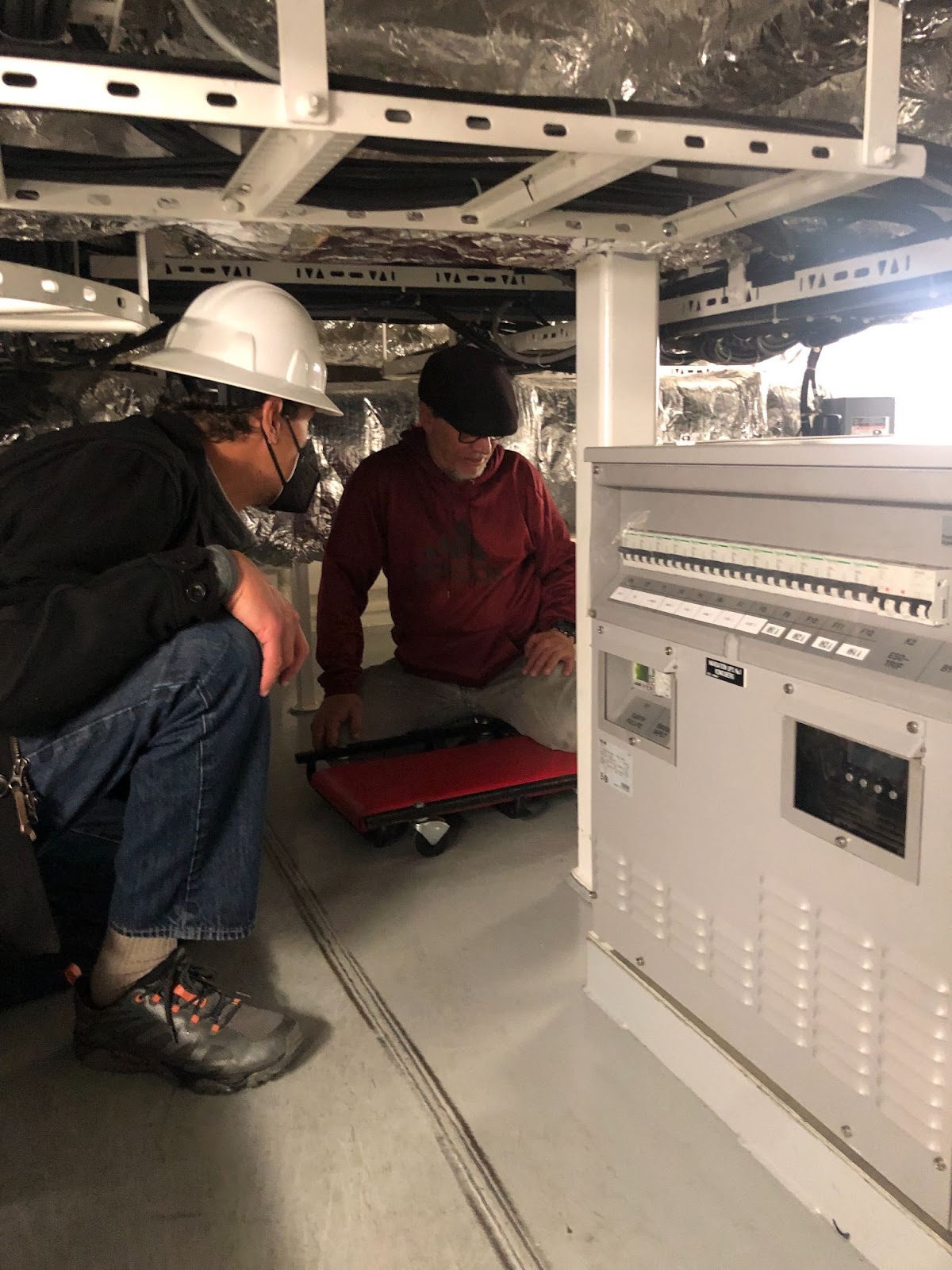
| Trusted CI’s Sean Peisert, left, in a crawlspace on the R/V Sally Ride examining operational technology systems. |
| The R/V Sally Ride, docked in Alameda, CA. |
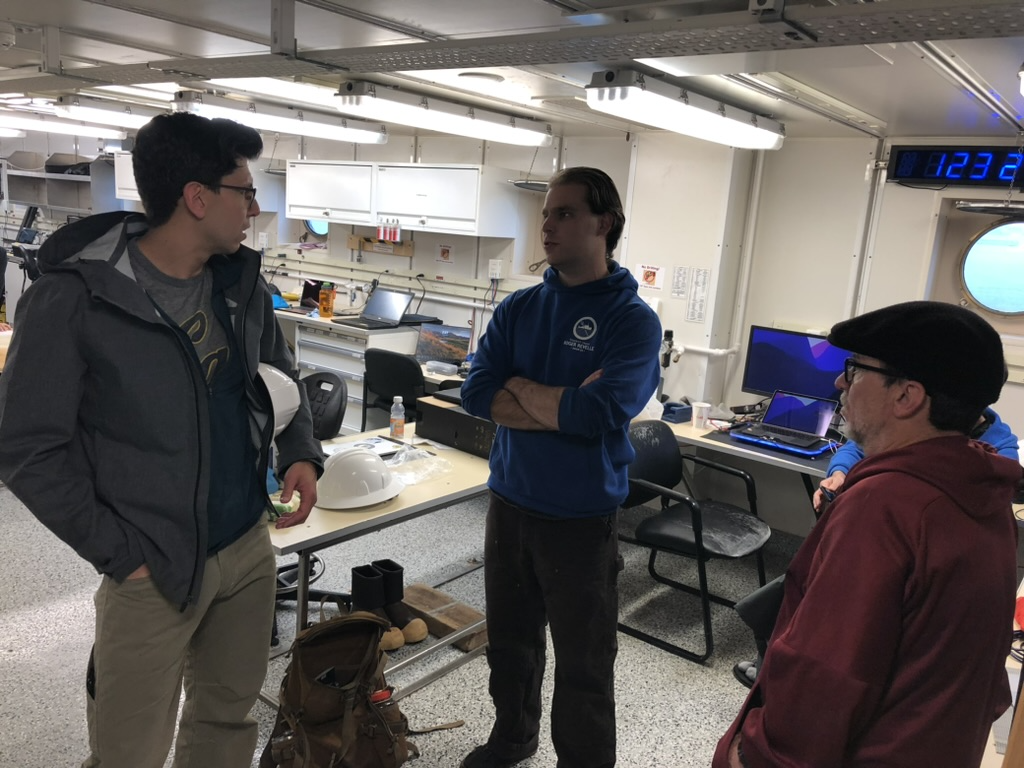
| Trusted CI’s Dan Arnold, left, conferring with marine technicians on the R/V Sally Ride. |
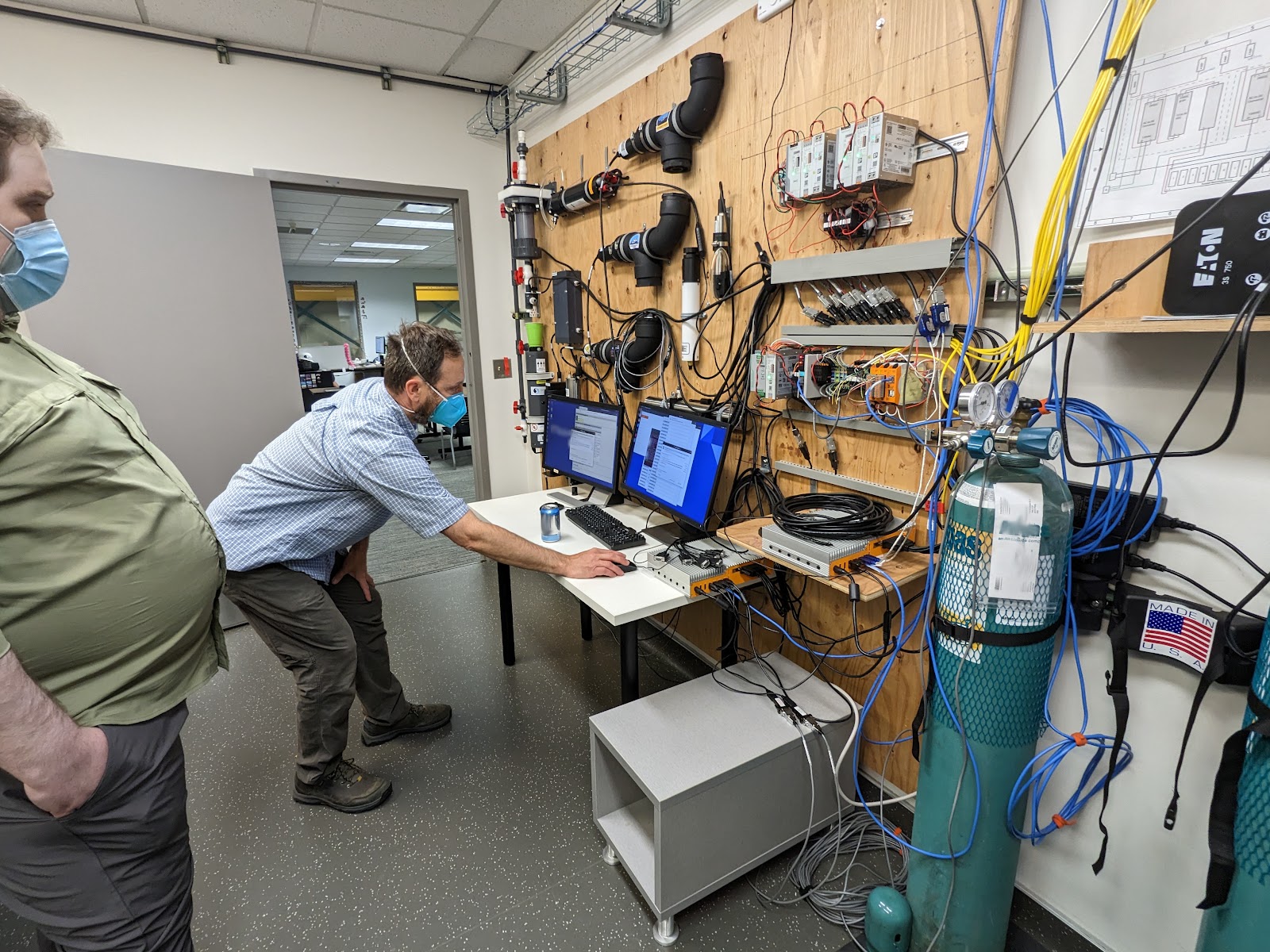
| Trusted CI’s John Zage, left, looks on as RCRV’s Chris Romsos, right, explains some of the scientific instruments that will be part of the newly constructed ships at the RCRV’s offices at OSU, Corvallis, OR. |
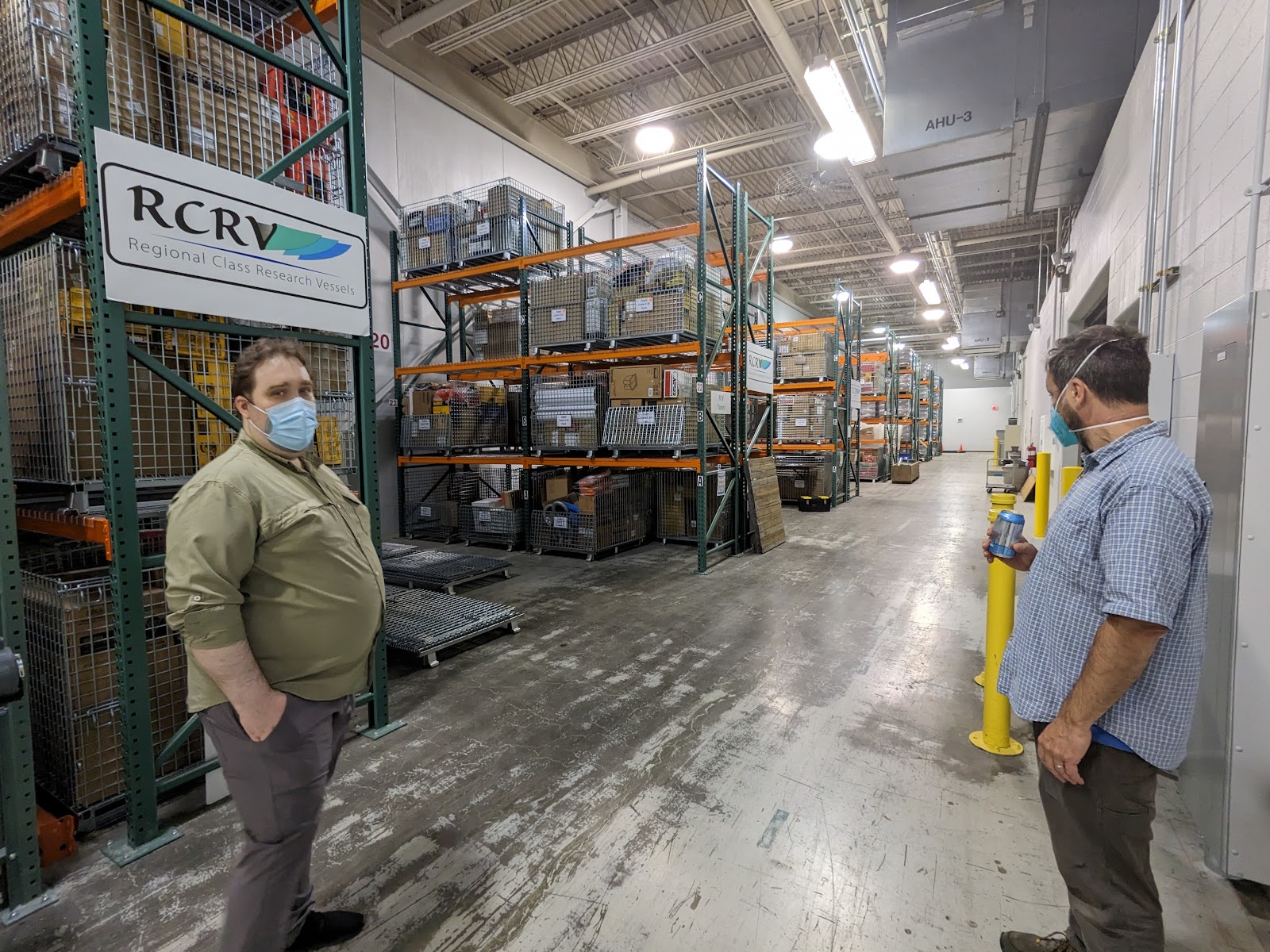
| Trusted CI’s John Zage left, and RCRV’s Chris Romsos, right, view part of the expansive warehouse of items and gear to outfit the new ships under construction. OSU, Corvallis, OR. |
Wednesday, February 15, 2023
Advancing the Cybersecurity of NSF Major Facilities and National Research Cyberinfrastructure: Trusted CI’s Framework Cohort Achievements in 2022
- Corporation for Education Network Initiatives in California (CENIC)
- FABRIC
- National Ecological Observatory Network (NEON)
- Seismological Facilities for the Advancement of Geoscience (SAGE)
The foundation of the cohort program is the Trusted CI Framework. The Framework was created as a minimum standard for cybersecurity programs. In contrast to cybersecurity guidance focused narrowly on cybersecurity controls, the Trusted CI Framework provides a more holistic and mission-focused standard for managing cybersecurity. For these organizations, the cohort was their first formal training in the Trusted CI Framework “Pillars” and “Musts” and how to apply these fundamental principles to assess their cybersecurity programs.
Concurrent with leading Bravo, Trusted CI continued engagement with the inaugural “Alpha” cohort through the end of 2022. Alpha cohort followed up on the success of the first half of the year by focusing on implementation challenges each cohort member was currently facing. Each of the monthly workshops was led by a different cohort member, with the workshop focused on addressing a specific cybersecurity challenge that the facility was facing. The Trusted CI Framework team is exploring ideas to continue the productive engagement with the cohort alumni.
In January 2023 Trusted CI began a third Framework cohort engagement (“Charlie”). Charlie cohort includes the following organizations:
- Academic Research Fleet (ARF)
- Deep Soil Ecotron (DSE)
- Giant Magellan Telescope (GMTO)
- IceCube Neutrino Observatory (IceCube)
- Network for Advanced NMR (NAN)
- US Antarctic Program (USAP)
Trusted CI is excited to be working with these new sites to advance their understanding and implementation of cybersecurity programs and best practices!
For more information, please contact us at info@trustedci.org.
Wednesday, January 25, 2023
Announcing the 2023 Trusted CI Annual Challenge: Building Security Into NSF Major Facilities By Design
The Trusted CI Annual Challenge is a year-long project focusing on a cybersecurity topic of importance for scientific computing environments. In its first year, the Trusted CI Annual Challenge focused on improving trustworthy data for open science. In its second year, the Annual Challenge focused on software assurance in scientific computing. In its third year, 2022, the Annual Challenge focused on the security of operational technology in science.
The 2022 Annual Challenge on the Security of Operational Technology in NSF Scientific Research reinforced the notion that NSF Major Facilities, once constructed, can deploy operational technology that can have an operational lifetime of 15-30 years. However, there are typically no cybersecurity requirements during acquisition and design. In the 2023 Annual Challenge, Trusted CI staff will engage with NSF Major Facilities undergoing construction or refreshes in a hands-on way to build security into those Facilities from the outset. Trusted CI will directly support the planning for facility refreshes and construction with respect to operational technology and will particularly focus on the academic maritime domain, including supporting the acceptance testing of the NSF-funded Research Class Research Vessels (RCRVs) at Oregon State University, supporting the U.S. Antarctic Program (USAP)’s design of the Antarctic Research Vessel (ARV), and Scripps Institution of Oceanography’s design of the California Coastal Research Vessel (CCRV).
This year’s Annual Challenge is supported by a stellar team of Trusted CI staff, including Andrew Adams (Pittsburgh Supercomputing Center), Daniel Gunter (Berkeley Lab), Ryan Kiser (Indiana University), Mark Krenz (Indiana University), Michael Simpson (Indiana University), John Zage (University of Illinois, Urbana-Champaign), and Sean Peisert (Berkeley Lab; 2023 Annual Challenge Project Lead).
Wednesday, November 16, 2022
Publication of the Trusted CI Roadmap for Securing Operational Technology in NSF Scientific Research
Trusted CI is pleased to announce the publication of its Roadmap for Securing Operational Technology in NSF Scientific Research.
In 2022, Trusted CI conducted a year-long effort examining the security of operational technology in science. Operational technology (OT) encompasses broad categories of computing and communication systems that in some way interact with the physical world. This includes devices that either have sensing elements or control elements, or some combination of the two, and can include both bespoke scientific instrumentation as well as commercially-produced OT. In both cases, networked sensors and control systems are increasingly important in the context of science as they are critical in operating Major Facilities.
Trusted CI’s approach to this effort was to spend the first half of 2022 engaging with NSF personnel and operators of OT at NSF Major Facilities to understand the range of operational practices and evaluate potential deficiencies that lead to vulnerabilities and compromises. In the second half of 2022, leveraged our insights from the first half to develop a roadmap of solutions to sustainably advance security of scientific operational technology. The audiences for this roadmap include NSF, NSF Major Facilities, and Trusted CI itself.
In July 2022, Trusted CI published its findings from its study of the security of operational technology in science, conducted in the first half of 2022.
Emily K. Adams, Daniel Gunter, Ryan Kiser, Mark Krenz, Sean Peisert, Susan Sons, andJohn Zage. “Findings of the 2022 Trusted CI Study on the Security of Operational Technology in NSF Scientific Research,” July 13, 2022. DOI: 10.5281/zenodo.6828675 https://doi.org/10.5281/zenodo.6828675
Now, with the publication of this roadmap, Trusted CI aims to help NSF operational technology in cyberinfrastructure advance toward solutions. The full citation for the solutions roadmap is as follows:
Andrew Adams, Emily K. Adams, Dan Gunter, Ryan Kiser, Mark Krenz, Sean Peisert, and John Zage. “Roadmap for Securing Operational Technology in NSF Scientific Research,” November 16 2022. DOI: 10.5281/zenodo.7327987 https://doi.org/10.5281/zenodo.7327987
Trusted CI gratefully acknowledges the many individuals from NSF as well as the following NSF Major Facilities that contributed to the year-long effort that has led to this roadmap: IceCube Neutrino Observatory, NOIRLab, Ocean Observatories Initiative, United States Academic Research Fleet, and the United States Antarctic Program.
In 2023, Trusted CI will turn its focus toward working closely with several maritime-centric NSF Major Facilities and Major Research Equipment and Facilities Construction (MREFC) projects to offer guidance and recommendations for integrating operational technology security into those facilities for planning, design, and construction of new and refreshed facilities and instrumentation therein.
Friday, September 30, 2022
Trusted CI at 2022 NSF Research Infrastructure Workshop in Boulder
Earlier this month, members of Trusted CI presented a workshop at the NSF 2022 Research Infrastructure Workshop in Boulder, Colorado.
The Research Infrastructure Workshop was a four-day event on safety, cyberinfrastructure, cybersecurity, and science communication. The hybrid event included a poster session, social gatherings, site tours of NCAR’s Research Aviation Facility, GAGE, and NEON, and virtual ice breaker and speed dating sessions to facilitate networking opportunities for everyone. Several members of Trusted CI attended the multi-day event, making new connections with operational and senior leadership at major facilities, midscale facilities, and the NSF.
Our workshop on Friday targeted cyber security officers and focused on the JASON advisory report on Cybersecurity at NSF Major Facilities, cybersecurity guidelines in the Research Infrastructure Guide (RIG), a panel on building a cybersecurity program using the Trusted CI Framework, ransomware, and how the ResearchSOC supports NSF major facilities.
Representatives from the NSF, NRAO, OOI, GAGE, and the ResearchSOC presented and participated during the workshop. We thank Craig Risien (OOI), Wade Craig (NRAO), and Doug Ertz (GAGE) for participating in the Framework panel.
Trusted CI’s partner, CI Compass, led a cyberinfrastructure workshop earlier in the day that included panels on data management and workforce development.
We are grateful to the event organizers for giving us the opportunity to present, as well as meeting with our community members, both online and in-person.
Slides and videos from the event will be posted to the NSF Research Infrastructure Knowledge Sharing Gateway when they become available.
Tuesday, July 26, 2022
Advancing the Cybersecurity of NSF Major Facilities: Trusted CI’s Inaugural Framework Cohort Successfully Completes Six-Month Program (June 2022)
Trusted CI’s first Framework Cohort has successfully completed its initial six-month period of workshops designed to improve NSF Major Facilities’ alignment to the Trusted CI Framework. Each cohort member adopted the Trusted CI Framework as the foundation for their cybersecurity program. Additionally, each cohort member worked closely with Trusted CI to produce 1) a validated self-assessment of their cybersecurity program’s alignment with the Trusted CI Framework; and 2) a draft Cybersecurity Program Strategic Plan identifying priorities and directions for further refining their cybersecurity programs.The inaugural Cohort included the following NSF Major Facilities:
The success of the Framework Cohort is particularly notable as each of these facilities voluntarily adopted and rallied around the Trusted CI Framework as the foundation for their cybersecurity programs.
The foundation of the Cohort program is the Trusted CI Framework, which was created as a minimum standard for cybersecurity programs. In contrast to cybersecurity guidance focused narrowly on cybersecurity controls, the Trusted CI Framework provides a more holistic and mission-focused standard for managing cybersecurity.
For GAGE, LIGO, NRAO, NSO, and OOI, the Cohort was their first formal training in the Trusted CI Framework’s “Pillars” and “Musts” and how to apply these fundamental principles to assess and strengthen their cybersecurity programs. NOIRLab contributed their experience as an early adopter of the Framework, having previously completed a one-on-one Framework engagement with Trusted CI.
Feedback from members of the first cohort on their experience has been strongly positive:
Eric Cross, Head of Information Technology, National Solar Observatory, said the following about his experience:
"The TrustedCI Framework Cohort was a valuable experience. The process required us to research and reflect on our internal cybersecurity policies and procedures. The Cohort provided a platform to meet with other facilities and work through challenges with feedback from peers. The experience resulted in formal documentation that provided our organization's leadership clear direction to improve our cybersecurity program with specific short-term and long-term goals. I highly recommend this exercise for all NSF facilities."
Craig Risien, CI Systems Project Manager, Ocean Observatories Initiative, said the following about his experience:
“I found participating in Trusted CI’s first Framework Cohort to be exceptionally instructive and really enjoyed the opportunities to discuss cybersecurity challenges and lessons learned with Trusted CI and colleagues at other NSF Major Facilities. Working with Trusted CI on creating a validated self-assessment based on the Trusted CI Framework over the past six months has helped the Ocean Observatories Initiative (OOI) better understand the current state of its cybersecurity program. Being part of this cohort has also assisted the OOI with the development of a plan to fully implement the Trusted CI Framework and create a well-established and mature cybersecurity program. I look forward to the follow-on cohort sessions in the coming months.”
Trusted CI is continuing to support the first cohort through the end of 2022 by facilitating monthly workshops. Each facility will have the opportunity to lead a workshop in which they are encouraged to share their specific challenges and seek advice among the other cohort members.
Concurrently, Trusted CI is conducting its second cohort engagement leveraging the lessons learned from the first cohort. The second cohort includes the following organizations:
- Corporation for Education Network Initiatives in California (CENIC), a California research and education network
- International Ocean Discovery Program (IODP), an NSF Major Facility
- FABRIC, an NSF Mid-Scale Research Infrastructure Facility
- National Ecological Observatory Network (NEON), an NSF Major Facility
- Seismological Facility for the Advancement of GEoscience (SAGE), an NSF Major Facility
Trusted CI is excited to be working with these new facilities to advance their understanding and implementation of cybersecurity programs and best practices!
For more information, please contact us at info@trustedci.org.
Friday, July 15, 2022
Findings of the 2022 Trusted CI Study on the Security of Operational Technology in NSF Scientific Research
This year, Trusted CI is conducting a year-long effort on the security of operational technology in science. Operational technology (OT) encompasses broad categories of computing and communication systems that in some way interact with the physical world. This includes devices that either have sensing elements or control elements, or some combination of the two. Networked sensors and control systems are increasingly important in the context of science as they are critical in operating scientific instruments. Trusted CI is pleased to share its findings from this study, published in the following report:
Emily K. Adams, Daniel Gunter, Ryan Kiser, Mark Krenz, Sean Peisert, Susan Sons, and John Zage. “Findings of the 2022 Trusted CI Study on the Security of Operational Technology in NSF Scientific Research,” July 13, 2022. DOI: 10.5281/zenodo.6828675 https://doi.org/10.5281/zenodo.6828675
In support of this study, Trusted CI gratefully acknowledges the many individuals from the following NSF Major Facilities that contributed to this effort: IceCube Neutrino Observatory, NOIRLab, Ocean Observatories Initiative, and the United States Academic Research Fleet.
Now that Trusted CI has finished its examination of the current state of the security of OT in science, it will turn its focus to developing a roadmap of solutions to sustainably advance security of scientific operational technology, which will be published in late 2022.
Thursday, May 5, 2022
Call for Trusted CI Framework Cohort Participation
The Framework Cohort is a six month, group engagement aimed at facilitating adoption and implementation of the Trusted CI Framework among NSF Major Facilities. During the engagement, members of the cohort will work closely with Trusted CI to adopt the Trusted CI Framework at their facility, emerging with a validated assessment of their cybersecurity program and a strategic plan detailing their path to fully implement each Framework Must.Cohort members will participate in six monthly workshops (each three hours) and spend no more than eight hours each month outside of the workshops on cohort assignments. The second cohort will meet from July to December 2022.
If you have any questions, please contact us at info@trustedci.org.
.png)