Showing posts with label students. Show all posts

Thursday, January 30, 2025

Trusted CI: Relaunching and Expanding the Student Program

As cybersecurity continues to grow in importance across the scientific community, the need to cultivate the next generation of cybersecurity leaders is more critical than ever. Trusted CI is proud to announce the relaunch and expansion of its Student Program, designed to provide students with very useful insights, mentorship, and hands-on experiences in cybersecurity while fostering a cybersecurity workforce for all. Applications for the 2025 cohort open on February 3, 2025.
Why the Student Program Matters
For over a decade, Trusted CI has significantly impacted the NSF community by equipping researchers and institutions with comprehensive cybersecurity knowledge and resources. Our analysis revealed opportunities to extend this impact by engaging students from a wider range of academic fields, such as those in the NSF Education and Human Resources (EHR) and Biological Sciences (BIO) Directorates, as well as reaching out to new institutions not currently engaged in cybersecurity programs. The Student Program aims to ensure that perspectives from across all disciplines and institutions contribute to shaping the future of cybersecurity.
Alumni Insights: Mentorship and Impactful Experiences in Cybersecurity


On the Mentor Program
Sandra Darkson - University of New Haven, MS in Cybersecurity and Networks
“My mentor (Carolyn Ellis) is really one of a kind; she is among those few individuals who sees the potential in me and, at the same time, believes so much in me that this belief drives me to work harder, and strive for excellence. I am so fortunate enough to have her as my guide and mentor on my path.”
On the Poster Session
Nana Sarfo Dwomoh - Sam Houston State University, MS Information Assurance & Cybersecurity
“The 2024 NSF Cybersecurity Summit was a big, unforgettable platform for me as a Cybercorp  Scholar, where I presented my poster, "Defending Electoral Integrity in the Age of Cyber Warfare,"  which gave me the chance to share my research on how digital disinformation, botnets, and deepfakes are impacting elections.”
On Networking
Konstantin Metz - University of Central Florida, MS Cybersecurity and Privacy
“The event is unlike any other in the industry! It brings together industry professionals, faculty, and students from across the globe to learn, network, and collaborate on current and emerging cybersecurity issues. It gives students an unparalleled opportunity to learn and grow while showcasing some of their own work. I am honored to have been selected to present and cannot wait for next year!”
Abigail Whittle - Oregon State University, BS in Computer Science
“I had the opportunity to meet some incredibly interesting individuals. Overall, I would highly recommend this experience to other students in the future, as it was beneficial both professionally and educationally, and I took away a lot from it.”
On Capture the Flag
Dignora Castillo-Soto - Bay Path University, MS in Cyber Security
“The CTF session provided a hands-on experience that challenged my problem-solving skills. It was refreshing to participate in a group project, as collaboration helped me gain new insights that I wouldn’t have achieved working solo.”
On Summit Courses
Owen Seltzer - Northeastern University, MS Cybersecurity
“The talks and panel discussions were not only engaging but also thought-provoking, covering topics ranging from emerging threats to innovative protection strategies. As someone still exploring career paths in cybersecurity, I found the presentations particularly enlightening.”
Goals of the Program
The Trusted CI Student Program is committed to:
  • Providing Foundational Knowledge: Selected students will gain practical insights into cybersecurity through workshops, mentorship, and participation in the annual NSF Cybersecurity Summit.
  • Fostering Community: By actively recruiting students from a wide range of backgrounds, the program aims to create a supportive environment that values a variety of perspectives.
  • Empowering Advocacy: Students will serve as cybersecurity ambassadors in their communities, equipping their peers with knowledge and connecting them with Trusted CI for more complex challenges.
  • Building Long-Term Connections: Participants will join a growing network of Trusted CI alumni, opening doors to mentorship, networking, and career opportunities in the cybersecurity field.
What’s New in the Trusted CI Student Program for 2025?
The Trusted CI Student Program continues to evolve, and we are excited to share the enhancements coming in 2025! Designed to nurture the next generation of cybersecurity researchers, this program has been refined based on past participant feedback and our commitment to providing a more impactful experience. These changes reflect our goal to improve the program from what it has been and make it more valuable for the entire Trusted CI community, not just prospective students.
Larger Cohorts Over Time
While the program currently welcomes five students annually, our goal is to expand participation to 15 students in future cycles as resources allow. This growth ensures more students benefit from Trusted CI’s expertise.
Alumni Engagement
We recognize the value of long-term connections, which is why past participants will now retain access to valuable program resources and opportunities to attend the Trusted CI Summit. This fosters an ongoing learning community and professional network.
Focused Workshops and Mentorship
Students will gain deeper insights through tailored workshops and dedicated one-on-one mentorship sessions. These sessions will be led by Trusted CI staff and esteemed industry experts, ensuring a well-rounded educational experience.
Streamlined Application Process
To provide a holistic evaluation of applicants, the revised application process will require a personal statement, a professional biosketch, and letters of support. This approach ensures we select students who are not only qualified but also deeply passionate about cybersecurity.
These enhancements are part of our commitment to continually improving the program, ensuring that both new and returning members of the Trusted CI community benefit from its evolution. We look forward to welcoming the 2025 cohort and continuing to build a thriving community of cybersecurity professionals!
What Students Can Expect
The Trusted CI Student Program will run from May to November 2025, featuring webinars and workshops twice a month to foster growth and prepare students for careers in cybersecurity.
From their first day in the program, Students will:
  • Attend workshops on cybersecurity fundamentals, career development, and emerging trends.
  • Network with top professionals and researchers at the NSF Cybersecurity Summit, an annual conference dedicated to advancing cybersecurity in research and education. This event provides a unique opportunity to learn from experts, engage in discussions on emerging cybersecurity challenges, and build valuable connections within the field.
  • Work closely with mentors who will guide their growth and help them navigate the cybersecurity landscape.
  • Share their experiences through blog posts, presentations, and outreach activities, inspiring others to explore careers in cybersecurity.
Join a Community of Innovators: Apply for the Trusted CI Student Program

The Trusted CI Student  Program is not just about equipping students with technical skills; it’s about creating a community that values collaboration, and innovation. If you are a student passionate about cybersecurity or know someone who is, we encourage you to apply and join us in shaping a safer, more secure future for science and beyond.

Applications for the 2025 cohort open on February 3, 2025. For more information on how to apply, visit Trusted CI’s website or reach out to students@trustedci.org. Let’s build a stronger cybersecurity community together!

Tuesday, November 19, 2024

Students Praise the Summit for Networking, Collaboration, and Professional Development

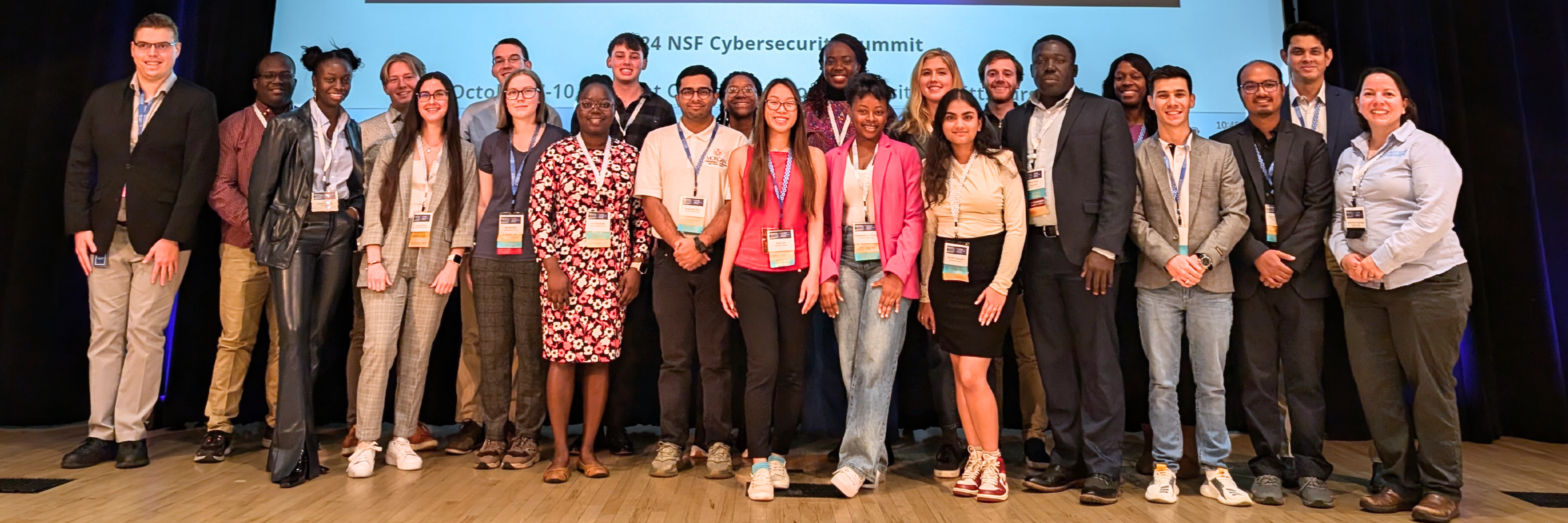
Trusted CI welcomed 18 students to the 2024 NSF Cybersecurity Summit, nine more than attended in 2023. They enjoyed four days of hands-on training, talks, panels, networking, and mentoring.

Here’s what students had to say about their experiences at the Summit with networking, capture the flag, poster sessions, and Summit courses.

On Networking

Konstantin Metz - University of Central Florida, MS Cybersecurity and Privacy
“The event is unlike any other in the industry! It brings together industry professionals, faculty, and students from across the globe to learn, network, and collaborate on current and emerging cybersecurity issues. It gives students an unparalleled opportunity to learn and grow while showcasing some of their own work. I am honored to have been selected to present and cannot wait for next year!”

Abigail Whittle - Oregon State University, BS in Computer Science
“I had the opportunity to meet some incredibly interesting individuals. Overall, I would highly recommend this experience to other students in the future, as it was beneficial both professionally and educationally, and I took away a lot from it.”

Istiak Chowdhury - University of Alabama at Birmingham, PhD in Computer Science
“One of the highlights was the social event at the Carnegie Museum of Art and Natural
History, a memorable gathering that facilitated great networking opportunities in a relaxed setting.”

On Capture the Flag

Nana Sarfo Dwomoh - Sam Houston State University, MS Information Assurance & Cybersecurity
“The biggest Summit highlight was the Capture the Flag (CTF) challenge, where students worked in teams to solve cybersecurity puzzles by finding vulnerabilities and cracking systems.”

Dignora Castillo-Soto - Bay Path University, MS in Cyber Security
“The CTF session provided a hands-on experience that challenged my problem-solving skills. It was refreshing to participate in a group project, as collaboration helped me gain new insights that I wouldn’t have achieved working solo.”

Iwinosa Aideyan - Clemson University, PhD Computer Engineering
“Another part of the summit I thoroughly enjoyed was participating in the CTF challenges. It was informative and exciting as we researched, learned new things, and collaborated with our teammates. It was a fantastic opportunity to deepen my understanding of practical cybersecurity concepts while strengthening connections within the team.”

On the Poster Session

Nana Sarfo Dwomoh - Sam Houston State University, MS Information Assurance & Cybersecurity
“The 2024 NSF Cybersecurity Summit was a big, unforgettable platform for me as a Cybercorp  Scholar, where I presented my poster, "Defending Electoral Integrity in the Age of Cyber Warfare,"  which gave me the chance to share my research on how digital disinformation, botnets, and deepfakes are impacting elections.”

Md Fazle Rabbi - Idaho State University, PhD in Computer Science
“I thoroughly enjoyed presenting my research poster. It was a great opportunity to receive constructive feedback from industry and academic experts. Their suggestions will undoubtedly help me refine my work and explore new avenues for future research.”

Riddhi Mahajan - University of Cincinnati, BS Information Technology
“I had the opportunity to present a poster showcasing my summer activities and ongoing projects, which was both exciting and rewarding. It was great to share my journey and hear about others’ experiences as well.”

On Summit Courses

Owen Seltzer - Northeastern University, MS Cybersecurity
“The talks and panel discussions were not only engaging but also thought-provoking, covering topics ranging from emerging threats to innovative protection strategies. As someone still exploring career paths in cybersecurity, I found the presentations particularly enlightening.”

Shameer Rao - Morgan State University, PhD Secure Embedded Systems
“The Summit was filled with engaging talks from top experts, which really broadened my understanding of the challenges we face in securing critical infrastructure. Overall, the Summit was an incredible mix of professional growth, hands-on activities, and connecting with like-minded individuals in the field.”

Dignora Castillo-Soto - Bay Path University, MS in Cyber Security
“What resonated with me most about the Cyberinsurance Challenges and Solutions session was the open and transparent dialogue. Having seasoned CISOs in the room added valuable perspective and fostered an honest conversation about the evolving landscape.”

On the Mentor Program

Sandra Darkson - University of New Haven, MS in Cybersecurity and Networks
“My mentor (Carolyn Ellis) is really one of a kind; she is among those few individuals who sees the potential in me and, at the same time, believes so much in me that this belief drives me to work harder, and strive for excellence. I am so fortunate enough to have her as my guide and mentor on my path.”

What’s Next for the Student Program

Going forward, there are plans to enhance the Trusted CI Student Program. The goal is to deepen engagement with students over a longer period and to bring more underrepresented groups into the cybersecurity workforce.

First, Hawa Naaata, the project lead for the Student Program, will gather feedback from current and past participants to assess program strengths, weaknesses, and areas for enhancement. Next, there will be more efforts to publicize the program.

More workshops and events will be added to impart practical skills and insights about cybersecurity. Also, there will be a sustained effort to facilitate attendance at the Summit, ensuring students gain exposure to industry discussions and professional development.

Finally, students will be encouraged to share insights, lessons learned, and personal success stories within their academic and professional networks.

Wednesday, December 6, 2023

Student Program at the 2023 NSF Cybersecurity Summit

In October, we hosted our annual NSF Cybersecurity Summit, which was a hybrid event hosted at Berkeley Lab. Our student program welcomed nine students to attend the in-person training sessions, present posters, network with fellow attendees, and introduce themselves to our community. We also matched students with mentors to help facilitate networking opportunities.

We give special thanks to our mentors: Ishan Abhinit, Jim Basney, Phuong Cao, Eric Cross, Wei Feinstein, Mark Krenz, Jim Marsteller, Sean Peisert, Kelli Shute, and Susan Sons.

We asked the students to share their thoughts on their experiences at the Summit. Below are their responses. These statements have been lightly edited for clarity.

Chad Callegari, University of South Alabama:
My experience at the 2023 Trusted CI Cybersecurity Summit completely exceeded my expectations in the best ways possible. I had never before attended a conference before this event, and as a student it was initially intimidating to be in a new environment with professionals from the field. I quickly learned just how inviting everyone at the event was, and everyone quickly made the environment one that I could feel comfortable in. I was able to learn so many new things from the trainings that were put on, and meet so many great people both other students and professionals. The event allowed me to learn about the different opportunities that I had not ever known about before and I was also able to talk with many of these professionals about potential opportunities for the future. The event was a great success for me and I hope to participate in other Trusted CI events in the future!

Matheu Fletcher, University of Illinois at Urbana-Champaign:
The summit was a great experience as my first real conference. My biggest personal takeaway was the friendliness and helpful nature of the community present. Similarly, the biggest technical aspect I learned from the event was gaining a better understanding of Zeek, along with various development tools I heard discussed that I can make use of to be more efficient in both work and personal projects. Additionally, I gained a better understanding of the ever-changing balance between creating and detecting AI generated texts.

Robert Johnson, The University of Tennessee at Chattanooga:
I thoroughly enjoyed my experience at the NSF Summit cybersecurity conference held at UC Berkeley. Not only were the surroundings gorgeous, but the organizers and attendees were extremely inviting. The more experienced members went out of their way to speak to first-time attendees providing networking opportunities. I believe it is important for students to familiarize themselves with the experience of attending a professional development conference. I enjoyed many of the talks and remained engaged despite the topics being niche and specific to different areas of cybersecurity. I am grateful to be able to speak with people from a variety of institutions, businesses, and countries and exchange knowledge.

Kaneesha Moore, Mississippi State University:
As a rather curious yet reserved individual, I was delighted to have TrustedCI’s 2023 NSF Cybersecurity Summit as my first professional conference. The atmosphere felt welcoming and inviting, and one could feel the passion for cybersecurity in the air – as cliché as it sounds. The workshops were intriguing and encouraged hands-on participation from other attendees which reinforced the topics discussed during the sessions. It is hard to choose a favorite, but I really enjoyed the workshops on artificial intelligence/machine learning and intrusion detection topics – Zeek, deep machine learning intrusion detection for SCADA (and similar) systems, and tutorials on detecting deepfake messages. It felt like an educational getaway with like-minded individuals who wanted to share and gain knowledge. I thoroughly enjoyed my time, and I hope to attend next year’s conference!

Ololade Odunsi, University of New Haven:
Attending the 2023 NSF Cybersecurity Summit was one of the best decisions I have ever made. I had the opportunity to meet industry professionals who were open to speaking with students and peers about topics they were interested in. From being paired with a mentor, to learning hands-on cybersecurity workshops and listening to seminars - the summit could not have been more value packed. I especially enjoyed the opportunity to present my poster on my background and projects I have worked on to the attendees, who were attentive and supportive.

Henry Schmidt, University of Arkansas:
I had a great experience at the Trusted CI NSF Cybersecurity Summit. It was fantastic to see and talk to the wide array of individuals who came to the conference. There was a considerable variety of seminars, talks, and workshops to attend. I liked in particular the talk on deep learning IDS by Dr. Ismail from Tennessee Tech as well as the security log analysis workshop by Mark Krenz, Ishan Abhinit, and Phuong Cao. It was a pleasure to talk with the other students and professionals from around the world at the conference. Everyone was genuinely interested in the work other people were doing in the cybersecurity space. Thank you to everyone that stopped by my poster to talk with me about the work that CyberHogs is doing with RazorHack Cyber Challenge at the University of Arkansas! I look forward to reaching out to everyone and carrying these connections with me as I move forward in my academic and professional career.

The Student Program has continued to be a very rewarding experience for us. If you are interested in becoming a mentor next year, please contact us at summit@trustedci.org.

Tuesday, June 6, 2023

Call for Participation for the 2023 NSF Cybersecurity Summit for Large Facilities and Cyberinfrastructure

 October 24th - 26th ✶ Berkeley, CA

https://trustedci.org/summit/

It is our pleasure to announce that the 2023 NSF Cybersecurity Summit is scheduled to take place the week of October 23rd. Starting with two  full days of trainings and workshops that will be held on Tuesday, October 24th and Wednesday, October 25th. Concluding with a full day of plenary sessions occurring on Thursday, October 26th.

The final program is still evolving, but we will maintain the mission to provide a format designed to increase the NSF community’s understanding of cybersecurity strategies that strengthen trustworthy science: what data, processes, and systems are crucial to the scientific mission, what risks they face, and how to protect them.

About the Summit

Since 2004, the annual NSF Cybersecurity Summit has served as a valuable part of the process of securing the NSF scientific cyberinfrastructure by providing the community a forum for education, sharing experiences, building relationships, and establishing best practices.

The NSF cyberinfrastructure ecosystem presents an aggregate of complex cybersecurity needs (e.g., scientific data and instruments, unique computational and storage resources, complex collaborations) as compared to other organizations and sectors. This community has a unique opportunity to develop information security practices tailored to these needs, as well as break new ground on efficient, effective ways to protect information assets while supporting science. The Summit will bring together leaders in NSF cyberinfrastructure and cybersecurity to continue the processes initiated in 2013: building a trusting, collaborative community and seriously addressing that community’s core cybersecurity challenges.

The Summit seeks proposals for plenary presentations, workshops/trainings, BoFs/project meetings, poster session and student program. 

Proposing Content for the Summit

There are many ways to contribute to the Cybersecurity Summit. We are open to proposals for live plenary presentations, focused workshops/trainings, project meetings and birds of a feather(BoFs). More specific information on each of those is available below. Submissions can be made using this online form https://docs.google.com/forms/d/e/1FAIpQLSc8VJjYj2XmzTxhoeBvQaf2LUCWovOCouMO5XQtdHgBjzOZDA/viewform by June 16, 2023. Responses will be announced by July 14, 2023 to ensure adequate planning time for presenters.

We strongly encourage proposals that address the 2022 Summit themes and challenges such as Framework Adoption, Operational Technology, Preparing for AI, Identity and access management, Compliance challenges and Risk assessment. Additionally, proposals that address topics ranked high by the community are also strongly encouraged/prioritized. These include: 

  1. Human Factors in Cybersecurity
  2. Open Source Software Security
  3. Cloud Security
  4. AI/ML for Security
  5. Trust/Security of AI Tools
  6. Information Asset Management
  7. Supply Chain Attacks
  8. ChatGPT use/banning/enabling for Security
  9. Quantum Computing

Proposing a Plenary Presentation

Please submit brief proposals with a 1-2 page abstract focused on NSF Large Facilities’ unmet cybersecurity challenges, lessons learned, and/or significant successes for presentation during the Summit Plenary Session. Plenary talks are limited to 25 minutes in length including time needed for question and answers if desired. 

Please note that the Summit will offer a ‘hybrid’ model for remote attendees to participate and all plenary talks will be recorded and made available after the event. Proposals should only contain information without sharing restrictions. As a guide, all plenary presentations should be TLP:WHITE “information carries minimal or no foreseeable risk of misuse, in accordance with applicable rules and procedures for public release. Subject to standard copyright rules, TLP:WHITE information may be distributed without restriction.” 

Submission deadline: June 16th, 2023
Proposals can be submitted using this online form: https://docs.google.com/forms/d/e/1FAIpQLSc8VJjYj2XmzTxhoeBvQaf2LUCWovOCouMO5XQtdHgBjzOZDA/viewform
Word limit: 1-2 pages
Notification of acceptance: July 14th, 2023

Proposing a Workshop or Training Session

Continuing this year, the Summit will accept proposals for Workshops and Trainings seeking to build communities of practice related to the NSF CyberInfrastructure. Please submit brief proposals with abstract that includes the intended audience, description of what the workshop or training will cover and expected benefits for attendees. Examples may include table top exercises, focused discussions and activities on techniques and skills in a particular field, and collaborative information sharing among security professionals.

Workshops and Trainings will be scheduled to not overlap with the Plenary sessions. They can be of varying length ranging from one hour to a half day (3.5 hours). Workshops can be limited to a specific audience to provide confidentiality. For workshops that intend to limit participation, proposals should include requirements for attendees. For accepted workshops that have admission requirements, members of Trusted CI along with workshop organizers will review workshop registration requests to ensure they meet attendance requirements. Workshop and training organizers may choose to offer either in-person or a hybrid model to include attendees joining remotely via Zoom. Workshop/training organizers are encouraged to offer hybrid sessions to maximize participation. This includes running the Zoom (e.g., monitoring the chat, unmuting remote participants, etc.). 

Submission deadline: June 16th, 2023
Proposals can be submitted using this online form: https://docs.google.com/forms/d/e/1FAIpQLSc8VJjYj2XmzTxhoeBvQaf2LUCWovOCouMO5XQtdHgBjzOZDA/viewform
Word limit: 1-2 pages
Notification of Acceptance: July 14th, 2023

Birds of a Feather and Project Specific Meeting Proposals

New this year we will be offering Summit attendees to propose Birds of a Feather (BoFs) and Project Specific Meetings. 

Birds of a Feather (BoFs): Informal gatherings of like-minded individuals who wish to discuss a certain topic can be 1-2 hours in length. Proposers of BoF sessions should serve as discussion leaders to explore and address challenges for a specific topic. BoF Proposals should be no more than one page in length and include the proposed topic and description, the activity’s intended audience, and its expected benefits.

Project Specific Meetings: The Summit organizers recognize that the summit attracts many people who work remotely on projects with distributed staff (ACCESS, ESNet, OSG, Zeek, Jupyter).  Attending a conference presents an opportunity for people who work collectively on a shared project to meet in person. This year we have a number of meeting rooms available for projects to hold working sessions. To request a meeting room, please provide a name and description of the project, number of expected participants and meeting duration (1-2 hours suggested). Requests will be reviewed and scheduled based on room availability. 

Submission deadline: June 16th, 2023
Proposals can be submitted using this online form: https://docs.google.com/forms/d/e/1FAIpQLSc8VJjYj2XmzTxhoeBvQaf2LUCWovOCouMO5XQtdHgBjzOZDA/viewform
Word Limit: 1-2 page description
Notification of Acceptance: July 14th, 2023

Poster Proposals

Also new this year we will be offering individuals to present posters in an informal setting. This is an opportunity to disseminate your work with Summit attendees, receive helpful insights and engage others who are interested in the same subject or focus of your work.

To propose a poster, please provide your name, poster title along with an abstract. Details on shipping posters will be provided upon acceptance.

Submission deadline: June 16th, 2023
Proposals can be submitted using this online form: https://docs.google.com/forms/d/e/1FAIpQLSc8VJjYj2XmzTxhoeBvQaf2LUCWovOCouMO5XQtdHgBjzOZDA/viewform
Word Limit: 1-2 page description
Notification of Acceptance: July 14th, 2023

Student Program

To support workforce development, the Summit organizers invite several students to attend the Summit in-person. Both undergraduate and graduate students may apply. No specific major or course of study is required, as long as the student is interested in learning and applying cybersecurity innovations to scientific endeavors.

To be considered, students must submit an application form (link below), answering questions about their field of study and interest in cybersecurity. Up to 10 student applicants will receive invitations from the Program Committee to attend the Summit in-person. Attendance includes students’ participation in a poster session.

Travel and hotel accommodations will be provided. Students whose applications are declined are welcome to attend the Summit remotely.

The deadline for applications is Monday, August 28th at 12 am CDT, with notification of acceptance to be sent by Friday September 8th.

Please discuss attendance with your instructors prior to attending.

We cannot select applications to attend in-person from students who live outside the United States.

Student Application to attend the Summit:
https://forms.gle/wxCRYpD94mCbQ4Rb6
Send questions to students@trustedci.org
Submission deadline: Monday, August 28th at 12 am CDT
Notification of Acceptance: Friday, September 8th

Notes for First-Time Presenters

The Summit organizers want to encourage those who have not presented at previous Summits to share their experiences, expertise, and insights with the NSF cybersecurity community. You don’t need to be perfectly polished, you just need to have something to share about your project or facility's experience with information security. Feedback from past Summits show that there is a great deal of interest in “lessons learned” type presentations from projects who’ve faced cybersecurity challenges and had to rethink some things afterwards. We’ve put together a page of tips and ideas for new presenters, including proposal and presentation tips as well as suggested topics. More direct coaching is available upon request.

Additional Call for Participation (CFP) Guidance

The Summit organizers wish to encourage and support participation from throughout the wider NSF community. To further that mission, we’ve provided some information (below) to aid in the preparation of CFP responses. Please don’t hesitate to direct questions to CFP@trustedci.org.

What to Present

The CFP presents an opportunity for the community to make progress on shared challenges identified in prior summits. The organizers especially appreciate proposals that drive this home; however, not every presentation or activity has to be centered around just that topic. Please submit any idea that you think may be relevant to our audience but note that proposals that address community challenges from prior years will be given higher preference. 

We strongly encourage proposals that address the 2022 Summit findings and topics identified of high interest as outlined above.

How to Build a CFP Response

The proposal you submit will be used in two ways: to tell the organizers about what you plan to present and to be included in the summit findings as a sort of after-action report. It should include:

  1. Session Format: Plenary (Lecture, Panel, Open Format) or workshop
  2. An executive summary/abstract (short description of the topic and content).
  3. Who the presenter(s) is/are.
  4. Either an abstract of the topic or a narrative you’d like to share with the community. (For activities that are not plenary sessions, this may be replaced with a description of the planned activity and the activity’s intended audience.)
  5. Contact information (preferably email) for the presenter(s) in case the organizers have any questions. This can be in a separate note in the email body instead of the proposal itself if presenter(s) don’t wish it to be published.
  6. Expected length of the session/activity. All plenary sessions will be limited to 25 minutes, Workshops and Trainings can range from one to 3.5 hours. BoFs and Project specific meetings are suggested to run 1-2 hours.
  7. Intended audience and expected benefits of the proposal

Our community has expressed in the past that many find it helpful if they can download a copy of a presentation’s slides. Therefore we will require all presenters to submit their slides in advance of the summit. 

The easiest way to get help/feedback from the organizing committee prior to submitting your final proposal is to create a Google Doc containing your proposal and sending an edit link to CFP@trustedci.org. 

Tips for Presenting

There are many different presentation formats that can work well depending on the topic. Consider the following:

  1. Lecture format: The presenter(s) talk to the audience and show slides to support their dialogue, then do a short Q&A session at the end of the presentation.
  2. Panel format: 3-5 persons answer questions offered by a moderator on a specific topic or set of topics, then do a short Q&A with the audience. This tends to work out best when the panel contains people with very different backgrounds or viewpoints, and the moderator is good at keeping folks to the topic and time constraints.
  3. Open Forum format: 2-3 persons answer questions offered by the audience. Works best if there is an extra person gathering questions and presenting them, and if the speakers can keep things succinct so that the presentation keeps moving and many questions get answered.
  4. Hands-on format(workshops/trainings): The presenter(s) walk the audience through a demo or tutorial as the audience follows along on their computers (or on paper, if the topic supports it).  If you are doing a training that will have many hands-on activities, consider having more than one presenter, or a presenter plus a helper or two who can go around the room and help participants who get stuck, allowing the group as a whole to move on.

Thursday, November 17, 2022

Student Program at the 2022 NSF Cybersecurity Summit

In October we hosted our annual NSF Cybersecurity Summit. This year’s Summit was a hybrid event hosted at the Monroe Convention Center in Bloomington, IN. It was our first Summit with a face-to-face component since 2019. Our student program welcomed ten students to attend the in-person training sessions, network with fellow attendees, and introduce themselves to our community. We also matched students with mentors to help facilitate networking opportunities.

We give special thanks to our mentors: Ishan Abhinit, Fatema Bannat Wala, Mark Krenz, and Jim Marsteller.

We asked the students to share their thoughts on their experiences at the Summit. Below is a selection of their responses. These statements have been lightly edited for clarity.

Jacob Abbott, Indiana University, PhD in Informatics


While at the 2022 NSF Cybersecurity Summit I attended the “Regulatory Compliance for Research,” and “Physical Security,” workshops that gave substantial information before the plenary sessions started. During the course of the event, I was able to meet Doug Ertz from UNAVCO and we realized that we have a mutual acquaintance in industry and we both have mentored students in partnership with the Center of Excellence for Women & Technology. Hearing discussions from professionals in different research areas and backgrounds, such as one presentation about all the facilities and requirements for high powered magnetic field generators, was very interesting and just shows how ubiquitous the issues of cybersecurity are for everyone.

Jessy Ayala, UC Irvine, PhD in Software engineering

At the 2022 NSF Cybersecurity Summit, I had the pleasure of networking with student peers from different universities, professors, and cybersecurity professionals. It was a great opportunity to have fruitful conversations with those who tackle security problems from a different perspective and overall learn about relevant issues we face today because of emerging, and pre-existing, technologies. I'm glad I can keep in touch with some of the people I met and look forward to any collaborations that may arise.

Tria Correll, Middle Georgia State U, Bachelor's in Information Technology

Besides the knowledge I gained from the pre-conference training, the biggest takeaway from attending the 2022 NSF Cybersecurity Summit was the opportunity to connect with fellow cybersecurity students and professionals. I learned a great deal about the importance of physical security and gained insight into why there are security risks when using a command line interface. I hope I'm able to attend next year's Summit in Berkeley, CA.

Xinyao Ma, Indiana University Bloomington, PhD in Security Informatics/Data Science

My research interests focus on usable security, and how to help people safely use the Internet from a user's angle. It was my first time attending such a great Summit and having the chance to meet so many people who are also working and researching in the cybersecurity field. I attended two very useful workshops, got to know many people that I haven't had a chance to meet, and learned a lot about what other cybersecurity people are doing. I'm a Ph.D. student in the usable security area, and most times, I have to work and study alone. Most connections come from my school and the lab. The Summit gave me a chance to get to know many other students and professors who also work in this area, and especially thanks to my mentor James Marsteller, who was really nice when I was afraid because I didn't know anyone before.

Rajvardhan Oak, UC Davis, PhD in Computer Science

The 2022 NSF Cybersecurity Summit was a great learning experience for me. It was an opportunity to learn cyber security skills through theory as well as hands-on exercises and keep up to speed with the latest in the field. It was also an excellent forum to network with industry professionals, fellow students and faculty. This has resulted in a fruitful collaboration for me; I am currently in touch with a fellow student and in the process of designing a research project in cyber security. I’m very fortunate that I was able to attend the Summit!

Harsh Parekh, Louisiana State University, PhD in Information Systems

2022 NSF Cybersecurity Summit's student program had an eclectic mix of students from diverse academic backgrounds. The Summit gave me immense networking opportunities with interdisciplinary researchers and practitioners in the cybersecurity space. I have already started some collaborative research projects through networking made possible through the Summit. Being a behavioral security researcher, I had a limited understanding of technical and developmental cybersecurity research which was rightly introduced through workshops such as log analysis and machine learning in cybersecurity. The student program was well planned with designated mentors, Summit events, social nights, and a tour of IU's massive data center. I really enjoyed my time in Bloomington and would like to be associated with the Summit in the future.

Mahmoud Shabana, NYU Tandon School of Engineering, MS Cybersecurity

The NSF Cybersecurity Summit was a great experience as my first in-person cybersecurity conference! I was fortunate to learn about how machine learning can be pivotal in implementing cyber defense tools, as well as new security techniques in log analysis. Outside of workshops, I got to meet professionals in all fields of security research and development. Connecting with current security researchers and practitioners has helped expand my network in security and learn from leading experts from around the world!

Joshua Thornburgh, University of Arkansas, MS in Computer Science

This Summit was the first of its kind for me to attend. Coming into it, I wasn’t sure what to expect or what the Trusted CI Framework was really about, not to mention a bit of imposter syndrome for even being invited. That was quickly dissolved once I began speaking with people. Everyone was extremely nice and had loads of wisdom to share. Having sat through the workshops for both machine learning in cybersecurity and the overview of the Framework, I can say with confidence that what I gained will really aid in my future paths. While the Trusted CI Framework is currently not something I can utilize as a student, that I have seen yet, I will carry it with me for when I do need it. Coming to the 2022 NSF Cybersecurity Summit was a true honor and I look forward to participating in this community in the future.

Alexs Wijoyo, Pace University, MS in Cybersecurity

The NSF Summit brought much clarity to the impact of cybersecurity at every scale no matter what industry you are in. Interacting with many of the individuals that were in charge of implementing the TrustedCI Framework and the mentors, I learned that there's always a place for security even at the lowest level. I learned many skills in the pre-conference workshops regarding command line security and log analysis with the use of ELK Stack as well as making many memories with the peers that I was able to spend my time with. My best moment is touring the University of Indiana data center and looking at the infrastructure that the school has built to support the endeavors of the staff and their students.

Alenna Zweiback, Indiana University, Bachelor's in Information Systems and Cybersecurity

I had an incredibly influential experience at the 2022 NSF Cybersecurity Summit. Prior to the conference, I was interested in learning more about how I can further my skills and career development in cybersecurity. By attending this conference, I was able to meet a variety of like-minded students, professors, researchers, consultants, and many other unique individuals. I became mindful of new internship opportunities. I envisioned long-term career paths.  Throughout the conference, I absorbed just how necessary it is for more people to be aware and involved in cybersecurity. My biggest takeaway from this conference was from keynote speaker, Helen Patton. When discussing the evolution of cybersecurity she quoted Mikko Hyppon in saying, “We are no longer securing just computers - we are securing the society.” By attending this conference, I was able to take one more step in educating society.

We are so proud of our student attendees and look forward to what they do in the future.

Tuesday, October 27, 2020

Student Program at the 2020 NSF Cybersecurity Summit

In September we hosted our annual NSF Cybersecurity Summit for Large Facilities and Cyberinfrastructure. This year's event was hosted online, which presented some challenges as well as new opportunities to broaden our audience. This is especially the case with our student program. Without the budget constraints of travel and hotel accommodations, we were able to allocate more registration seats to students than in previous years. This year twenty-seven students, from inside and outside the US, joined us for three days of hands-on training, talks, panels, and active Q & A sessions.

Because our student attendance was significantly larger than in previous years, we decided to host a panel specifically targeted toward their interests. Prior to the Summit we asked the students to vote from a list of topics. They selected "Multidisciplinary in Cyber: Research, education, and industry." Our panelists (names listed below) included senior leadership in cybersecurity institutions as well as experts in crime and psychology. They talked about the various efforts in research, education, and industry to engage these domains to gain a more holistic approach to cybersecurity. One key takeaway was the panel's emphasis that a diverse group of backgrounds and interests can enhance an organization or project's security posture. And, some light but practical advice, remember to "Marie Kondo" your attack surface. The fewer apps you manage on your devices, the better off you will be.

We asked the students to share their thoughts on their experiences at the Summit. Below are a selection of their responses. These statements have been edited for brevity and clarity.

Posie Aagaard; Master's in Information Technology with Cyber Focus, University of Texas San Antonio (LinkedIn)

The conference was very well organized and information about the conference was clearly communicated in advance, which helped me plan. I appreciated the pre-recorded sessions and was able to view them in advance. Richard Biever’s and Ken Goodwin’s vulnerability scanning/honeypot session, and Pablo Morian’s session on cyberinfrastructure protection using machine learning, made me wonder, “Why didn’t I think of that?”

The session moderators did a super job of being punctual, informative, and keeping that human element in the virtual sessions. Thank you for recording some sessions, and thanks to the presenters for sharing slides as they were able.

I found Kate Starbird’s keynote on disinformation to be fascinating and relevant to the discussions organizations should be having about cybersecurity. The humor and candor in Jerry Brower’s "Gemini’s Policy Laxative," was welcome and informative. Susan Son’s "Speak Their Language," included some gems of advice that I am sure I will reference in my future briefings.

The Tuesday training session was a great bonus. I liked the technical hands-on aspect and the ability to ask presenters questions along the way. I attended Bart Miller’s and Elisa Heymann’s session. They did a lot to prepare ahead of time.
Hristina Jovanoska; Associate's in Cybersecurity/Information Assurance, Ivy Tech Community College (LinkedIn)
I thank the NSF for choosing me to represent this year's student program. I learned so much that I will take with me in my career. It was a great experience for all three days of the Summit. Thank you again. Stay safe and healthy, and I'm looking forward to next year's Summit.
Krunal Mahant; Master's in Computer Security, Rochester Institute of Technology (LinkedIn)
This was my first experience as a student to be a part of an event that involves such a large number of candidates. The best part about the Summit was that everyone I interacted with had the same mindset as me: to share experiences and learn from one another. I attended the Web Security tools training session and was instantly inspired by the experiences shared by both Prof. Bart Miller and Elisa Heymann. Each session had so much information packed in a very organised way that it never felt overwhelming at all. Apart from the training day, I was part of the "Build a Cybersecurity Culture with Tabletop Security Exercises" by Josh Drake. It was a fun and insightful experience as there were topics discussed in the session that I had never imagined were important in building the security culture. It gave me good knowledge about how organizations in the industry use techniques to develop security habits. All in all, my experience was great and I would love to continue being part of NSF Cybersecurity Summit each year. Thanks a lot for accepting me as a participant.
Eric Tatman; Bachelor's in Intelligent Systems Engineering, Indiana University Bloomington (LinkedIn)
I really enjoyed keynote speaker Kate Starbird's presentation on disinformation. I thought it was a very insightful presentation, particularly when she shared overlays of her models depicting how the sources of disinformation not only come from opposing factions in contemporary social movements, but some of the disinformation somes from the same source. This showed that some of the disinformation sources are not only acting on both sides, but they are using their ability to manipulate what each different factions are focused on at a certain time.
Trusted CI thanks the members of the student panel, and the students themselves, for making this year's Summit a success. As always, the students' participation and enthusiasm is a rewarding affirmation of our commitment to community building.

Student Panel Moderators

  • Jeannette Dopheide - Senior Education, Outreach, and Training Coordinator at the National Center for Supercomputing Applications (NCSA) at the University of Illinois
  • Aunshul Rege - Associate Professor at Temple University

Panelists

  • ​Dr. Tonya Davis - Assistant Professor at Alabama A&M University
  • Kevin Metcalf - Chief Executive Officer for the National Child Protection Task Force
  • Helen Patton - Chief Information Security Officer at the Ohio State University
  • ​Rodney Petersen - Director of the National Initiative for Cybersecurity Education (or NICE) at the National Institute of Standards and Technology (NIST)